

Unlock Free Shipping on orders $100+ 🔓
Summer Sale! Celebrating America's 250th Enjoy 40% OFF Sitewide!
Canvas Wall Art Buying Guide:
Materials, Frames & Quality Standards
Investing in wall art requires a clear understanding of the physical materials and manufacturing techniques that separate short-lived prints from gallery-grade heirlooms. Because a canvas is an architectural element exposed to ambient light, humidity, and structural tension, understanding product specifications is vital to avoiding premature fading, canvas sagging, and frame warping. This comprehensive technical buying directory is engineered to pull back the curtain on professional printing standards, equipping you with the exact knowledge needed to evaluate art assets confidently.
Through our detailed consumer guides, you will learn how to decode canvas textile compositions, analyze archival ink chemistry, evaluate internal wooden chassis construction, and choose the correct external framing treatments for your space. Explore our technical product breakdowns below to ensure your next canvas investment retains its structural integrity and vibrant color profiles for decades to come.
HOME / WALL ART GUIDE / CANVAS WALL ART BUYING GUIDE
Ultimate Wall Art Guide
Materials Science, Framing Engineering & Art Quality Standards —
• Poly-Cotton Blend vs. Cotton vs. Polyester • Printing Technology & Archival Ink Chemistry
• Internal Stretcher Bar Frame Engineering • Canvas Edge Wraps (Gallery vs. Museum vs. Mirror)
• Modern Floating Frames vs. Unframed Canvases • Canvas Weight, Density, & Weave Grading (GSM Factors)

Choosing the Right Canvas —
Cotton vs. Polyester vs. Poly-Cotton
Why a Poly-Cotton Blend is the Smarter Choice for Your Home?
For most residential wall art, a poly-cotton blend is the gold standard. It perfectly pairs the rich, tangible texture of natural cotton with the rugged dimensional stability of polyester. This engineered weave holds its shape far better than pure cotton, preventing distracting sagging, warping, or wrinkling as your indoor humidity shifts throughout the seasons. The result is a flawlessly smooth, ultra-durable surface that delivers razor-sharp details and vibrant color consistency for decades.
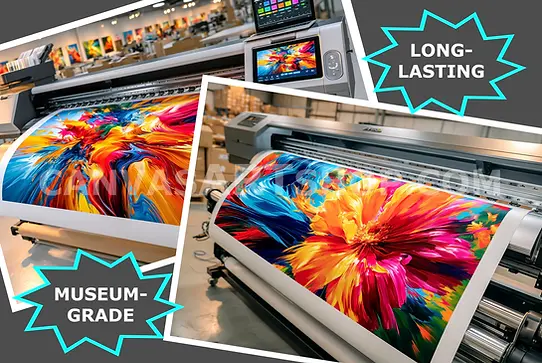
Giclée Printing & Archival Ink Technology
What Are Archival Pigment Inks—And Why Do They Matter?
Unlike cheap, dye-based inks that quickly fade under ambient sunlight, museum-grade archival pigment inks use advanced, mineral-based formulas engineered to resist UV degradation. When paired with high-definition Giclée inkjet technology, these microscopically fine pigments lock permanently into the canvas fibers. This premium process ensures breathtaking color accuracy, rich velvety blacks, and incredibly smooth gradient transitions that preserve your artwork's original visual integrity for a lifetime.
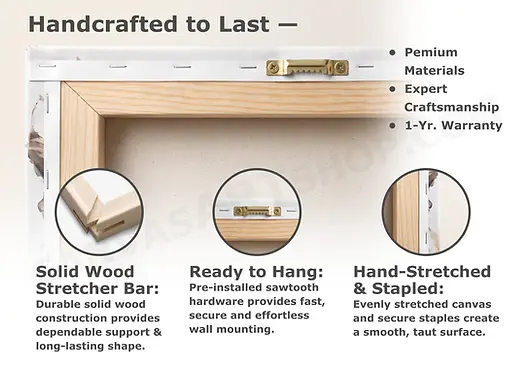
Inside a Gallery-Wrapped Canvas —
Construction & Craftsmanship
What makes a stretched canvas durable and resistant to warping or sagging?
When buying canvas wall art, look beyond the print. High-quality gallery-wrapped canvas uses straight, kiln-dried wood stretcher bars, reinforced corners, even tension and secure rear stapling to help prevent warping, bowing and sagging. Larger canvases may require added support. These hidden construction details determine how securely the artwork hangs, maintains its shape and lasts in changing indoor conditions.
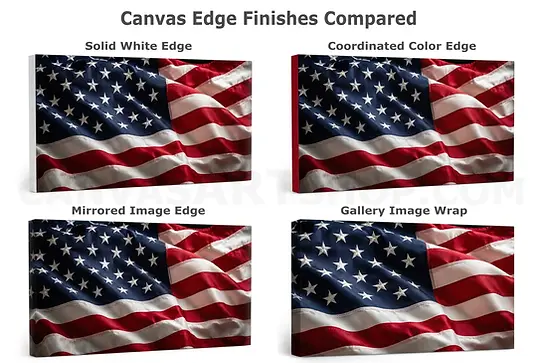
Canvas Edge Finishing Options —
Gallery vs. Mirrored vs. Solid Color
Which canvas edge finish is best for your artwork?
Gallery Wrap — Your image stretches around the wooden sides for a modern 3D effect. Best for a desired continuation of the image and perfect for landscapes & seamless abstracts.
Mirrored Edge — Software mirrors the photo borders onto the sides. Keeps 100% of your image visible on the front face—ideal for portraits.
Solid Color Border — A crisp color choice from the image or an all-white wrap frames the sides cleanly without stretching background elements or altering composition.

Canvas vs. Framed Art —
Which Is Best for Your Home Style?
The Rise of Frameless Art: Why Gallery Wraps Are Trending
Traditional framed prints often create rigid visual barriers, while frameless gallery wraps offer a sleek, seamless transition that complements modern, minimalist, and open-concept interiors. Eliminating the bulky outer border allows the artwork to blend naturally with your wall texture and room lighting, making spaces feel larger and less cluttered. Because high-end canvas wraps carry no extra frame weight, they are significantly safer to hang on any drywall without heavy-duty anchors.
